Milton GA Estate Homes and Equestrian Living Explained
July 9, 2026
July 9, 2026
Looking for more space in Milton often starts with a simple idea: you want privacy, land, and room to breathe. But when you begin seeing terms like estate and equestrian, the line between the two can get blurry fast. If you are trying to understand what those labels really mean, what they cost, and what to double-check before you buy, this guide will help you sort through it. Let’s dive in.
Milton’s estate and equestrian appeal is tied closely to how the city is laid out. According to the City of Milton, the area is home to more than 200 active horse farms, and those farms are spread throughout the city rather than grouped into a single neighborhood.
That matters because Milton’s horse presence is part of the broader landscape, not just a niche tucked into one development. The city also maintains a Milton Equestrian Committee that meets monthly to consider matters important to the local equestrian community. That ongoing local focus helps explain why horse properties remain such a visible part of Milton’s identity.
Milton’s zoning pattern also supports larger parcels. The city says AG-1 is its most common zoning designation and covers much of Milton, with future AG-1 lots generally set at 1 acre or more and a minimum lot width at the building line of 150 feet. The city defines a large lot as 3 acres or bigger, which gives you a useful baseline when comparing properties.
In Milton, estate-style properties typically refer to homes on larger lots that offer privacy, deeper setbacks, tree cover, and room for features beyond the house itself. You may see space for a pool, guest accommodations, outdoor entertaining areas, or long private drives.
The main value here is often the land and the setting. These homes appeal to buyers who want a quieter, more private residential feel without necessarily needing agricultural or horse-related infrastructure.
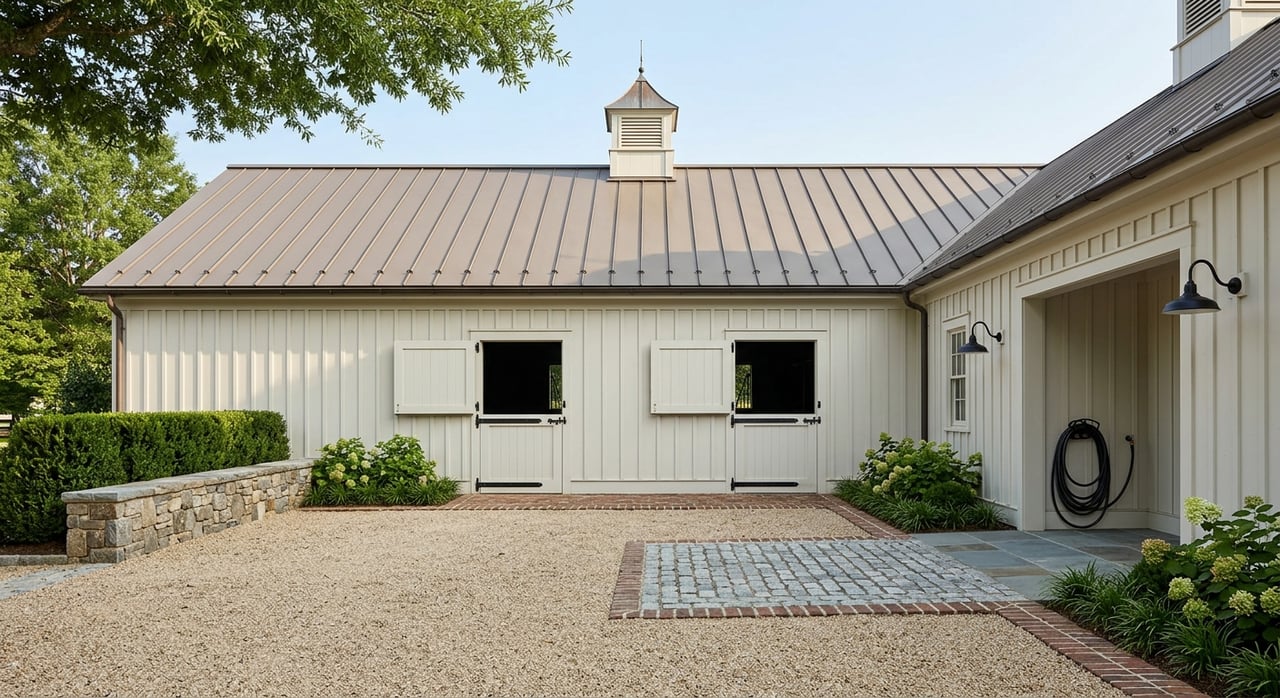
Equestrian-style properties build on that larger-lot appeal but add horse-specific features. That can include barns, run-in sheds, fenced pastures, paddocks, riding arenas, trailer access, wash areas, tack storage, and hay storage.
Milton’s local rules recognize horse facilities as a distinct use. In the Rural Milton Overlay, the city lists rural-friendly fence types such as split rail and horse wire, while prohibiting chain-link, PVC, and vinyl fencing in that section.
A large lot does not automatically mean a horse-ready property. Some homes are simply acreage properties designed for privacy and residential use, while others are set up for active equestrian use.
The City of Milton notes that local horse farms can range from a few horses to a dozen or more. That tells you this market includes everything from hobby-level setups to more intensive private horse properties, so the details of the site matter a lot.
Milton is already a higher-price market before you add acreage or horse improvements. As of April 30, 2026, Zillow reported an average home value of $953,443 and a median sale price of $993,500 in Milton. Redfin reported a three-month median sale price of $1.1 million for sales ending in May 2026.
Horse-ready homes sit within that larger market but remain a niche category. At the time of review, Realtor.com showed 39 Milton listings with horse stables, which suggests there is active inventory, but not in large numbers.
Current listing examples show how much pricing can widen once acreage and equestrian improvements enter the picture. Reported examples included an 11.89-acre estate on New Providence Road listed at $2 million, an 18.2-acre gated estate on Hopewell Road listed at $3 million, and a 6.51-acre equestrian estate on Wood Road listed at $4.875 million.
For buyers, the practical takeaway is simple. You are often budgeting for two things at once: the premium for land, privacy, and rural character, and the additional premium for horse infrastructure that is already built and functional.
One of the most common questions buyers ask is how much land is enough. UGA Extension offers a useful rule of thumb for Georgia: a mature horse often needs about 2 acres of perennial pasture in non-cropping-type land.
That guideline is a starting point, not a guarantee. The actual amount of usable land depends on forage, feed strategy, soil, layout, and how the property is managed over time.
This is one reason two properties with the same acreage can function very differently. A 3-acre parcel may feel spacious for residential living, but that does not automatically make it practical for horse use, especially if part of the land is wooded, sloped, wet, or constrained by setbacks and utility needs.
Milton’s zoning framework is an important first stop in your due diligence. Because the city has continued reviewing possible AG-1 small-lot amendments, parcel-by-parcel verification is important rather than relying on general assumptions about the area.
If you are considering horse use, you will want to confirm how the specific property is zoned and how that zoning lines up with your intended use. That is especially true if you are comparing a private horse setup with a property that may be used more actively.
Milton’s animal code adds another layer. The code requires livestock enclosures to be well drained, sanitary, and free from odors. It also sets a 150-foot minimum distance from occupied buildings for horses, mules, asses, cows, sheep, and goats.
Outside agriculture-zoned areas, the code also limits the number of horses or cows on a single premises and requires 150 square feet per horse in the enclosure. These details can affect whether a property that looks appealing online will actually support your plans once you study the layout.
If you are wondering whether you can board horses or run lessons, that is not just a land-size question. Milton’s code treats public and commercial horse facilities differently from private keeping, so the answer depends on zoning and permitting.
That distinction matters because a property that works well for personal use may not be suited for a more business-oriented setup. If your goals go beyond private enjoyment, the review process needs to be especially careful.
Horse properties can be beautiful, but they also come with ongoing work. UGA Extension notes that rail and plank horse fences are attractive and highly visible, but they can be expensive to build and may require significant maintenance over time.
Mesh and electric fencing options come with their own tradeoffs as well. Before you buy, it helps to look beyond curb appeal and ask how much repair, replacement, and pasture management the property may require in the near future.
UGA Extension also advises that fence lines should be located carefully on surveyed property lines before permanent installation. On larger parcels, that step can help you avoid costly mistakes and boundary issues later.
Drainage is one of the most important practical issues on a horse property. Milton’s stormwater guidance notes that runoff from developed areas can contribute to flooding and erosion, which makes low spots, paddocks, barn surroundings, and turnout areas worth careful inspection.
If possible, it is smart to see the property after rain or review how water moves across the site. A layout that looks ideal on a dry day may present a very different maintenance picture once the ground is wet.
Milton says the city does not provide water or wastewater service to residents. Homeowners typically rely on private service or Fulton County Water Services, and if a homeowner does not pay for wastewater service, they are likely on septic.
For large-lot and horse properties, septic is more than a box to check. The city notes that septic design depends on household size, soil type, slopes, lot size, and proximity to streams and lakes.
That means the way the home, barn, paddocks, driveway, and usable open space fit together can have real consequences. A property may have generous acreage on paper, but the functional layout still needs to be reviewed closely.
Holding costs can also look different on larger tracts. Milton’s large-lot guidance says Fulton County manages Georgia’s Conservation Use Value Assessment for qualifying agricultural properties, and the Georgia Department of Revenue says qualifying owners file for current-use assessment with the county board of tax assessors.
For some buyers, that may become part of the long-term budget conversation. It will not apply to every property, but on actively used agricultural or horse-related land, it is a topic worth exploring early.
Milton’s estate and equestrian market offers a very specific kind of lifestyle. You are often buying privacy, rural character, and land first, then evaluating whether the property is also truly workable for horses.
The smartest question is not just, “Is this lot big enough?” It is, “Does this property’s layout, utility setup, drainage, fencing, and zoning support how I actually want to use it?”
That kind of detail work can make all the difference between finding a beautiful acreage home and finding a property that truly fits your goals. If you want help sorting through Milton’s large-lot and niche inventory with a high-touch, local approach, Taylor Thompson can help you evaluate your options with clarity and confidence.
Stay up to date on the latest real estate trends.
Finding the right real estate agent can make all the difference, and I’m dedicated to providing the warm, professional, and informative service you deserve. Let’s connect and discuss your goals.